Home Think — Perception & Sensor Fusion Decide — On-Device Autonomy Act — Operator Control Strategic Consulting Pilot to Production Forward-Deployed Engineering Symage Platform Defense, Aerospace & Space Industry 4.0 Medical Technology AgTech Proof Blog Solving For Tomorrow Podcast Company Careers News Speaker FAQ Talk to the Team →
Engineering Leadership Briefing

Your prototype works. Now find out if it can ship.

AI made building software faster. The harder question is what still stands between a working prototype and production.

The AI Coding Reality Check examines the engineering work that comes after the demo, from failure handling and security to architecture, maintainability, operations, and ownership.

13 pages · Includes a 21-point production-readiness assessment

No sales pitch required. Just the briefing.

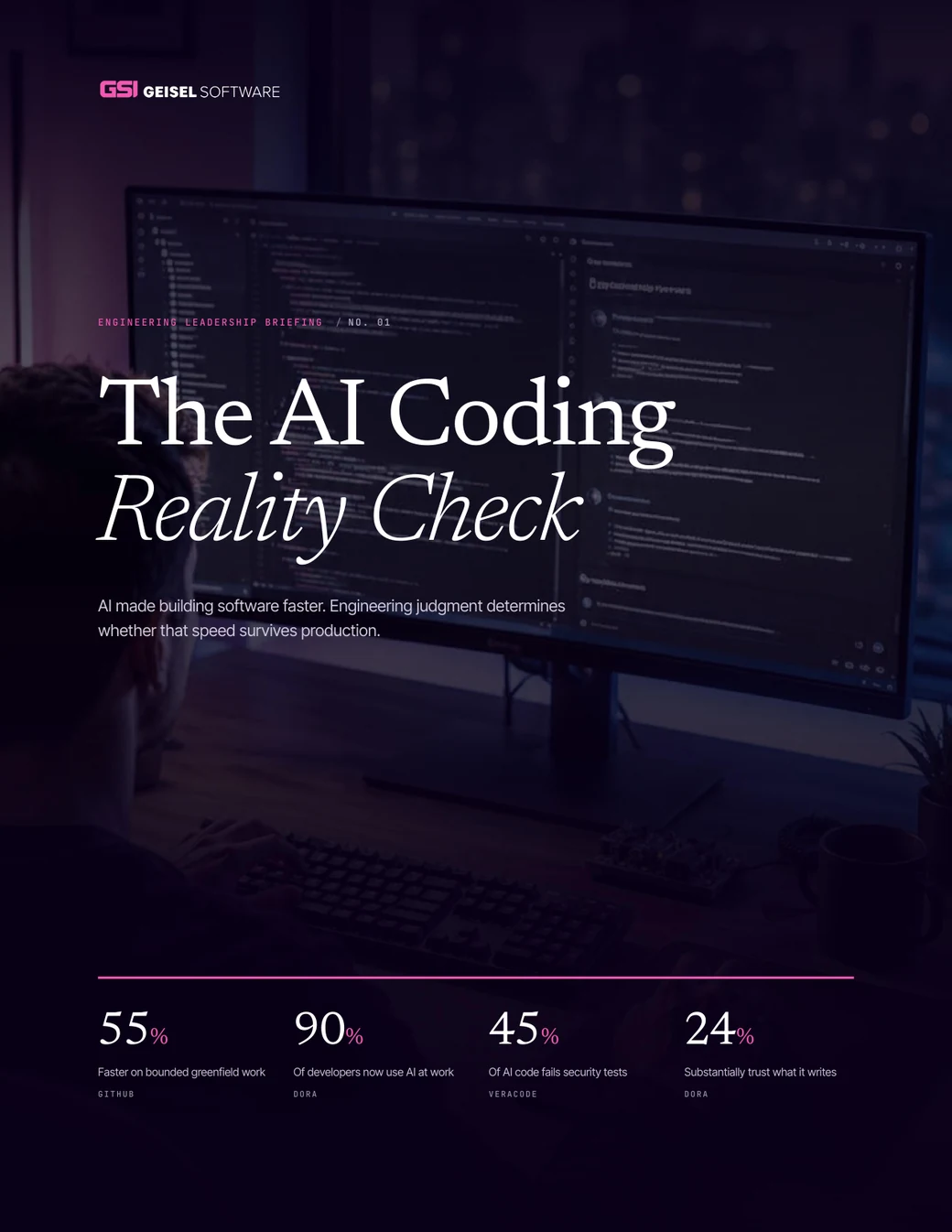
Cover of The AI Coding Reality Check, an engineering leadership briefing from Geisel Software.

The build is done. The decisions are not.

A working prototype can show up remarkably fast. It authenticates. It queries. It renders. It demos.

Then the questions change.

01

What happens when the network disappears mid-operation?

02

What happens when two writes hit the same record?

03

What happens when an input arrives that nobody tested?

04

What happens when a sensor stops reporting?

05

What happens when an actuator gets an unsafe command?

Those are not simply code-generation problems. They are engineering decisions, and they determine whether something that works in a demo can hold up in production.

Working code is not the same as production-ready code.

55%

Faster on bounded greenfield work

GitHub
90%

Of developers now use AI at work

DORA
45%

Of AI-generated code fails security tests

Veracode
24%

Substantially trust what AI writes

DORA

These are separate measurements from separate studies, each on its own population and task mix. The briefing carries the full citations, sample sizes, and the context that decides what each figure does and does not support.

Seven places to look before you call it production-ready.

01

Behavior

Does it work when reality stops cooperating?

Error paths, timeouts, retries, concurrency, and unexpected inputs.

02

Dependencies

Do you know what the system actually depends on?

Pinned versions, licenses, CVEs, and verified packages.

03

Security

Can it survive inputs designed to break it?

Secrets, authorization boundaries, validation, and applicable vulnerability classes.

04

Maintainability

Can somebody safely change it six months from now?

Sources of truth, duplicated logic, dead code, and error handling.

05

Architecture

Was the architecture chosen, or did it emerge?

Boundaries, state, interfaces, and documented decisions.

06

Operations

Can you tell when it is failing and recover it?

Logs, metrics, recovery behavior, and tested rollback.

07

Ownership

Who gets to decide that the system is ready?

Named owners, review responsibility, and the authority to say not yet.

AI can accelerate the work. It cannot define done.

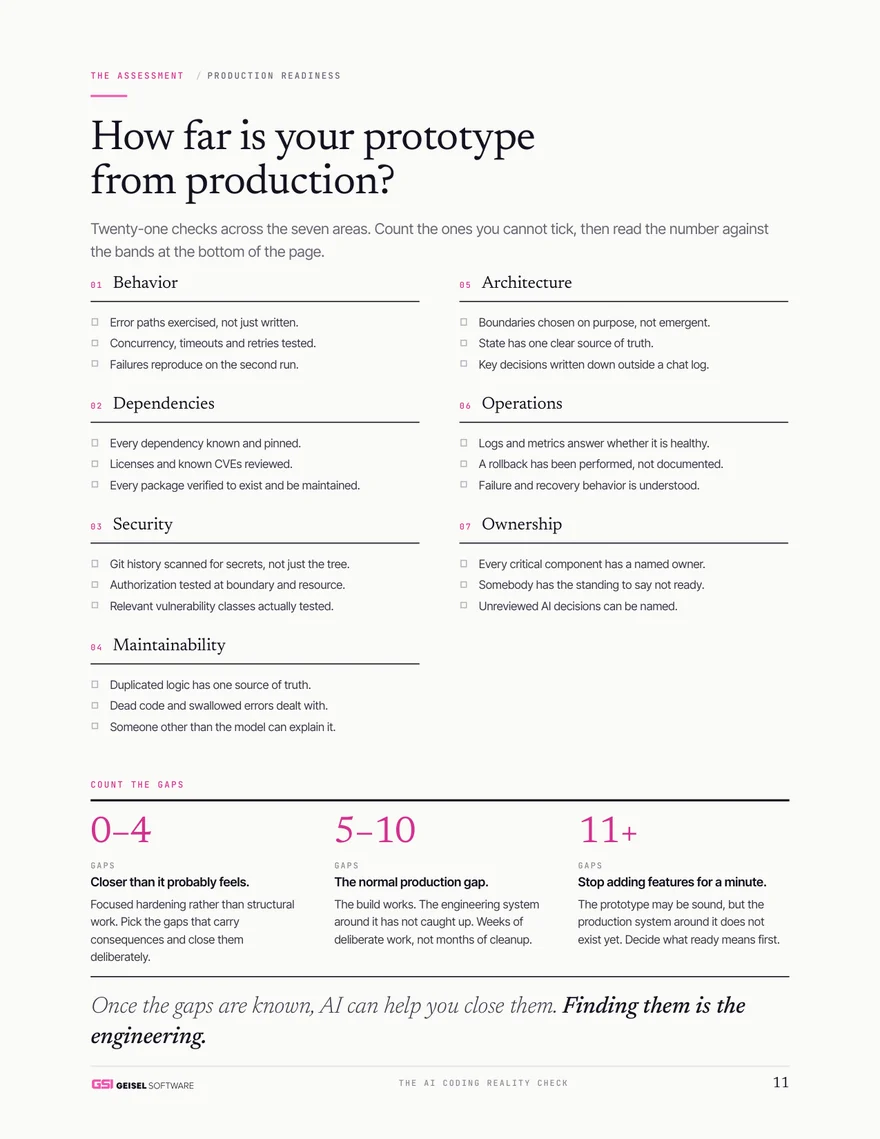
How far is your prototype from production?

The briefing includes a production-readiness assessment across all seven areas. Count the checks your build cannot pass and see where the biggest gaps are.

  • Error paths exercised, not just written.
  • Every dependency known and pinned.
  • Relevant vulnerability classes actually tested.
  • Duplicated logic has one source of truth.
  • Logs and metrics answer whether the system is healthy.
  • A rollback has been performed, not just documented.
  • Every critical component has a named owner.

Seven of the twenty-one. The rest, and the scoring bands that tell you what your count means, are in the briefing.

Page 11 · Production readiness

Research, not a sales deck.

Thirteen pages of third-party research on where AI helps, where it quietly costs, and what has to be true before an AI-built system is safe to deploy.

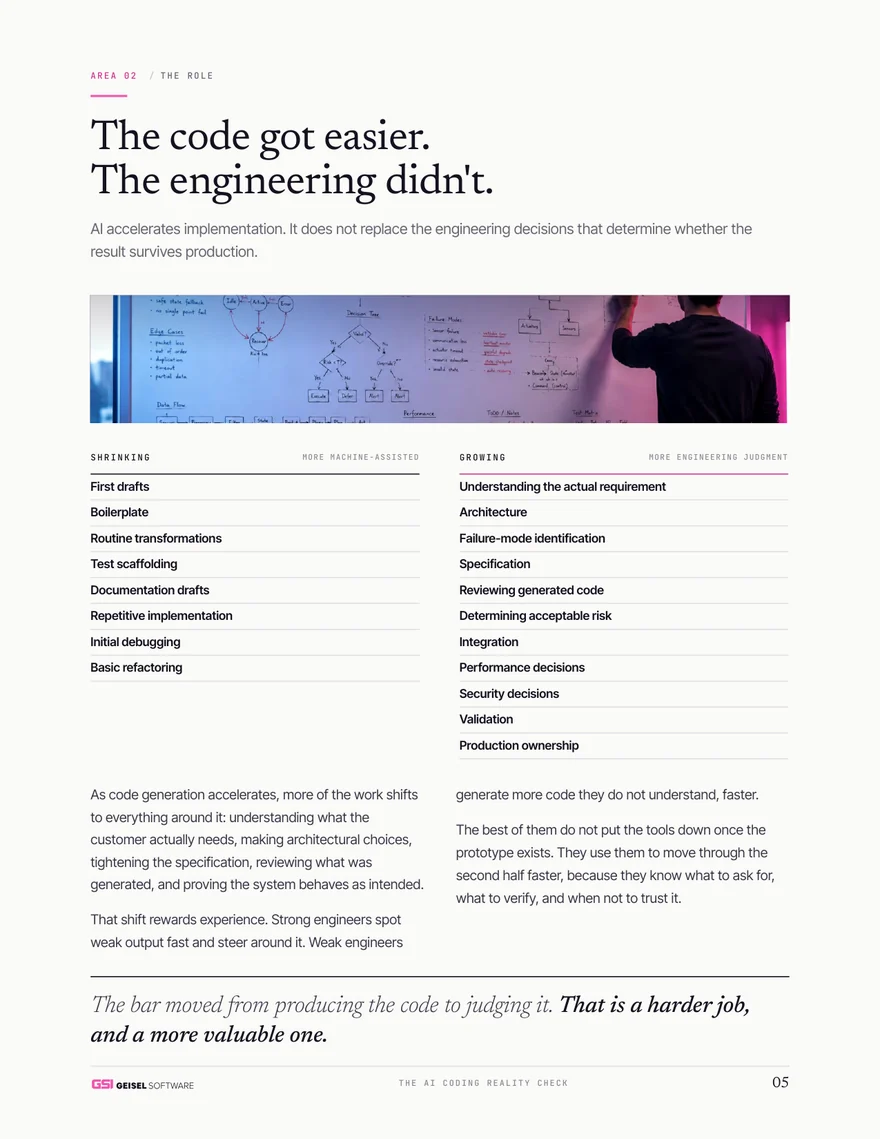
Page 05 · The roleThe code got easier, the engineering did not. What shrinks as generation accelerates, and what grows.
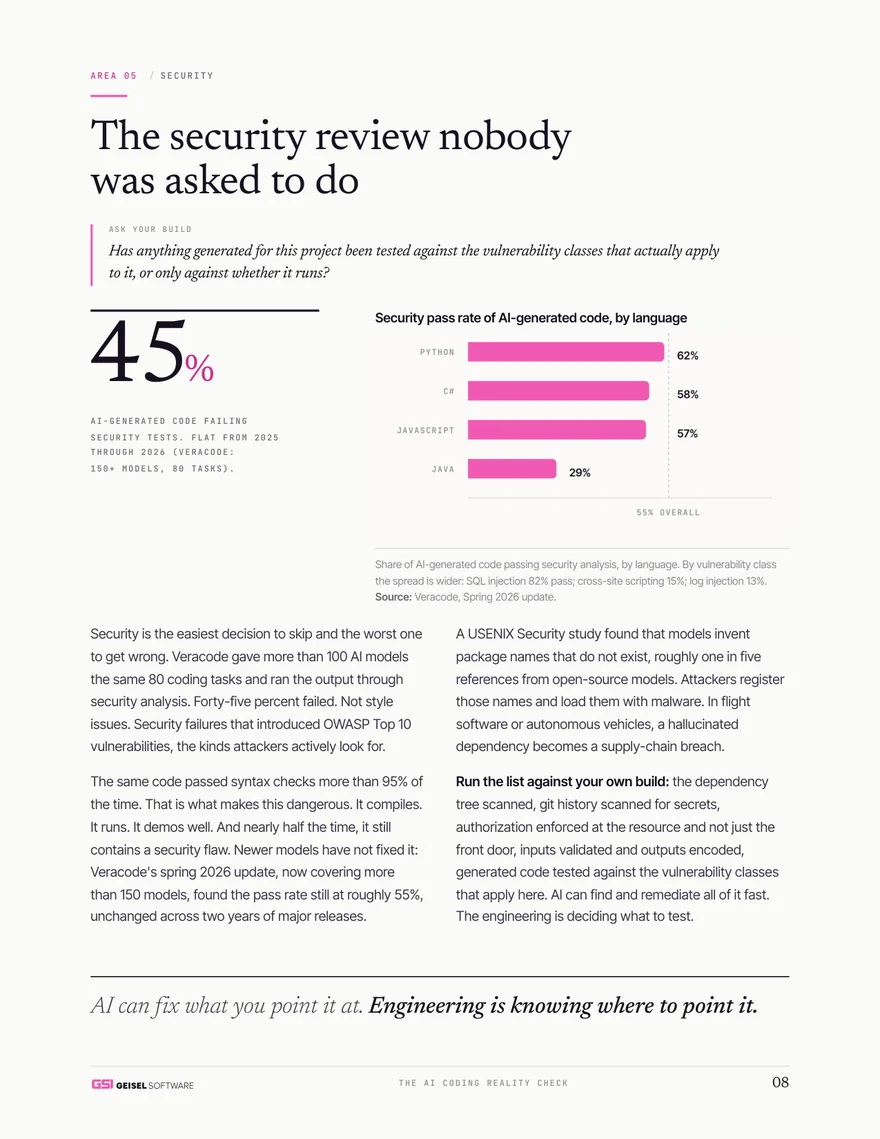
Page 08 · SecurityVeracode ran 80 tasks through 150+ models. The output compiles, runs, and demos, and 45% still fails security analysis.

Do not start over. Finish what you built.

Knowing what is between your prototype and production is useful. Closing those gaps is the next step.

The Geisel Prompt-to-Production Sprint starts with the prototype you already have, identifies the production risks that matter, and focuses the engineering effort on getting it ready to deploy.

3 weeks

Fixed engagement.

$25,000

Fixed price.

1 working prototype

Hardened, tested, and moved toward a deployable baseline in your own git.

The Sprint starts with a 30-minute Viability Review of the actual application. We identify the biggest production risks, decide whether the Sprint is a fit, and tell you what we would attack first.

Before you ship it, find the gaps.

Use the AI Coding Reality Check to evaluate your prototype across behavior, dependencies, security, maintainability, architecture, operations, and ownership.

Download the Technical Brief →

13 pages · 21 production-readiness checks · Research from GitHub, METR, DORA, GitClear, Veracode, and others.