Geisel is the engineering partner for AgTech teams building software that must perform in the real world, through unreliable connectivity, harsh environmental conditions, edge-device constraints, and field schedules that can’t slip.
The hardest software in agriculture isn’t the part you see. It’s the part that has to keep working when the connectivity drops, the temperature swings, the dust gets everywhere, and the harvest window won’t wait.
Indoor farms, agricultural robotics, and precision ag teams share one engineering reality: their software has to perform in conditions most software wasn’t designed for. Cellular coverage is unreliable. WiFi doesn’t reach the row. Edge compute runs in heat and vibration. Sensors drift, equipment fails, weather changes everything overnight. None of this is a glitch. It’s the operating environment.
Geisel engineers software for those conditions. Our autonomous systems work was forged on the hardest version of the problem: building autonomous decision-making for the lunar surface, where unreliable connectivity, harsh conditions, and edge compute aren’t edge cases but the baseline. We carry the same engineering rigor into AgTech: software that runs offline, recovers cleanly when systems drop, and ships on a calendar that doesn’t slip when the field demands.
This is High-Consequence Software. Zero-Failure Engineering. Built for the field.
Whether you’re operating a vertical farm, fielding a fleet of autonomous tractors, or building the next generation of harvest automation, the underlying engineering breaks down the same way: a system has to perceive what’s happening, decide what to do, and act without breaking.
Computer vision, sensor fusion, and distributed sensor networks for crop monitoring, disease detection, harvest verification, indoor farm environmental sensing, and autonomous platform navigation. Engineered for edge deployment on rugged hardware operating in harsh real-world conditions including heat, vibration, dust, and intermittent connectivity where most software fails.
Explore Think →Autonomy software for agricultural robots, drones, precision farming platforms, and indoor farming operations including environmental control, automated harvesting, autonomous navigation, and decision-making in unstructured outdoor environments. Built with the same engineering rigor used to deliver autonomous decision-making on the lunar surface, now adapted for fields, rows, orchards, and controlled growing environments.
Explore Decide →Tractor cab interfaces, farm management dashboards, farmer-facing mobile applications, and operator consoles for indoor farming and agricultural robotics platforms. Designed for the realities of field operation including bright sunlight, gloves, intermittent connectivity, and operators who need software that works reliably the first time, every time.
Explore Act →Modern agricultural systems use all three. We build all three for the conditions the field actually presents.
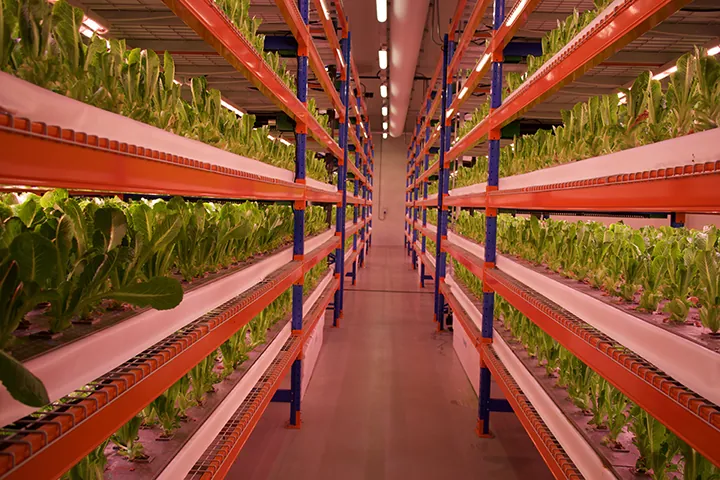
Software for environmental control, plant health monitoring, and harvest automation in vertical farms and controlled environment agriculture, where every micron of variance affects yield.
Embedded software and autonomy for tractors, harvest robots, and field platforms operating in dust, rain, GPS-degraded conditions, and unstructured terrain.
Computer vision and ML for crop monitoring, disease detection, weed identification, and yield estimation, including synthetic-data-trained models for rare crop conditions where real-world data is scarce.
Edge-to-cloud platforms for distributed equipment, environmental sensors, irrigation control, and farm operations data, built for the connectivity realities of rural and agricultural environments.
Every line of code we ship has to survive the field. That means it can’t fail when the tractor hits a GPS dropout under tree cover, can’t crash when a sensor takes a face full of dust, and can’t choke on the data volume from a fleet of robots working a 1,000-acre field in real time.
That standard is built into who we hire and how we work.
Our engineers have written software for autonomous platforms, embedded systems on rugged hardware, computer vision in unstructured environments, and connected operations spanning hundreds of pieces of equipment. They hold the deep expertise that doesn’t transfer easily: ROS and ROS2, real-time control on outdoor-rated embedded platforms, sensor fusion for GPS-degraded conditions, edge ML deployment, and the integration patterns that bring agricultural equipment into modern data platforms.
From American growers to vertical farming operators around the world, AgTech companies partner with a team that brings American engineering rigor and understands that in agriculture, schedules are driven by the weather, not by someone else’s time zone.

Crop One operates one of the largest commercial vertical farming operations in the world, growing leafy greens at industrial scale through highly automated indoor agriculture. Geisel Software engineered embedded systems and software for the sensor-driven operations that make commercial-scale indoor farming possible, turning growing facilities into instrumented, software-controlled environments where every plant, every condition, and every harvest cycle is observable and optimizable.
Read the full case study →We engineer directly for indoor farming operators, agricultural robotics companies, autonomous tractor manufacturers, precision ag platforms, and ag equipment makers. Whether you’re building a vertical farming operation, scaling an autonomous platform, developing a harvest robotics product, or modernizing precision ag software, we’d like to talk.
How customers typically work with us: