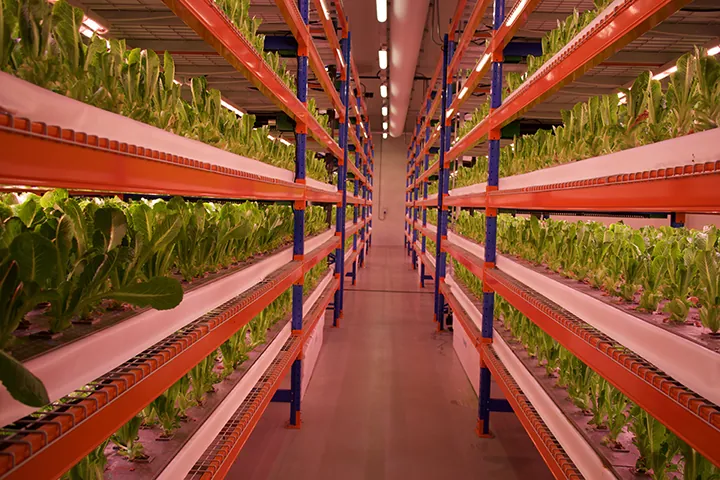
// 01, The Challenge
At that scale, farming isn’t manual. It’s software.
Thousands of pumps, valves, sensors, and switches across more than 20 modular growth units have to operate continuously, precisely, and reliably, because the crop doesn’t wait for a bug fix.
Scaling software from a Massachusetts headquarters to a commercial operation in Dubai is not a straightforward deployment. ECO 1’s construction accelerated in 2020 at the same time Crop One was onboarding new members to their Digital Systems team. The team had to learn, design, and refactor the Farm Manager software for a facility an order of magnitude larger than anything it had been built for, while continuing to support existing operations at headquarters in Millis, Massachusetts.
The software that ran a research and development farm had to become the software that ran the world’s largest vertical farm. Those are different problems.
// 02, What Geisel Built
Scaling and hardening mission-critical agricultural control software.
Crop One’s VP of Digital Systems, Derek Hui, had worked with Geisel on previous programs. When ECO 1’s scale made clear that the Farm Manager software needed significant work to get there, he brought Geisel in.
Geisel worked directly alongside the Crop One team to scale Farm Manager from its original deployment at the Millis headquarters to a fully commercial operation. The system controls and monitors thousands of pumps, valves, sensors, and switches across more than 20 modular growth units. Its Data Browser tracks, stores, and retrieves the history of thousands of data points and signals as frequently as every 30 seconds.
At that polling frequency, across that many data points, performance and stability aren’t nice-to-haves. They’re the difference between a farm that runs and one that doesn’t.
Performance, Stability, and Long-Term Supportability
The work Geisel delivered addressed the system across multiple layers. OPC-UA monitoring was stabilized using the latest asynchronous technology, with extensive logging implemented to make future debugging faster and less disruptive. API performance improved by more than 90% on the application’s status page and 24% on the controls page, meaningful gains in a system where operators are making real-time decisions based on what the interface tells them.
Library and package upgrades addressed security vulnerabilities and brought the system current with community support. The testing suite was evaluated, rebuilt with new examples, and expanded, giving the Crop One team a foundation for long-term stability rather than a system that required constant intervention to maintain.
The underlying data architecture was restructured to make the software easier to maintain and extend as ECO 1’s operations grow.
// 03, The Result
Farm Manager, deployed to ECO 1.
The nine-month collaboration successfully deployed Farm Manager to ECO 1. The software has been central to identifying and troubleshooting issues with PLC logic and overall system performance at both the Millis headquarters and in Dubai.
A farm producing three tons of leafy greens a day runs on software that can’t afford to be unreliable. That’s the standard it was built to.
ECO 1 isn’t a pilot or a proof of concept. It’s a fully operational commercial facility running at scale, every single day, in one of the harshest climates on earth. There’s no margin for “mostly right” or “fixed after a restart.” The software has to perform continuously and flawlessly, three tons of crops on the line, every day.
Crop One Holdings · ECO 1, Dubai