Turn Your AI Prototype Into Production Software
The demo worked. Now every fix is a game of whack-a-mole. Geisel's Prompt-to-Production Sprint transforms your AI-generated prototype into secure, tested, production-ready software in three to six weeks.
In a 30-minute conversation, we'll determine whether your application is a fit for the Prompt-to-Production Sprint and identify the biggest launch risks.
01 The production gap
The Demo Worked. The Launch Is Where Things Get Risky.
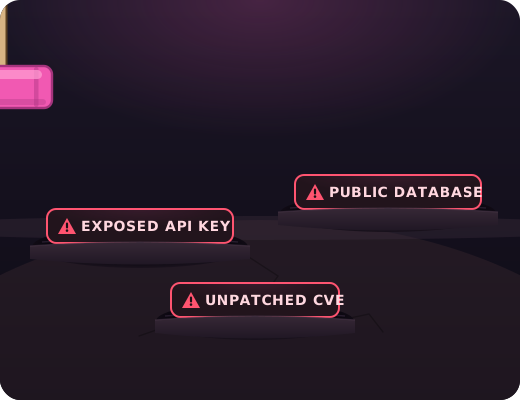
AI tools got you from idea to a working demo in days. That's the easy part now. Turning that demo into production software is where the real engineering starts. Code written for a demo often hides secrets in the repo, skips the tests, pulls in unvetted dependencies, and leans on an architecture that was never asked to carry a real product. Before long, the codebase starts fighting you. Every fix uncovers another issue, confidence drops, and the launch date keeps moving.
What "it works" is hiding
- × Hardcoded secrets
- × Untested critical workflows
- × Dependency vulnerabilities
- × Fragile architecture
- × Missing CI/CD
- × Technical debt nobody understands
// You proved the idea works. Now prove it won't break.
02 The failure modes
Why AI-Built Applications Break in Production
Security Risks
Exposed credentials, vulnerable dependencies, weak authentication, and missing safeguards create launch risk.
No Testing Foundation
Changes become dangerous when no automated tests exist to catch regressions.
Architecture Debt
What worked for a demo often collapses under new features, user growth, and operational demands.
Ownership Risk
Teams inherit code they didn't write and cannot confidently maintain or extend.
03 Inside the sprint
One AI-Built Application. Secured, Tested, and Production-Ready.
In three to six weeks, Geisel engineers take one AI-generated application from a working demo to a secure, tested, production-ready baseline. Every phase has a defined focus and concrete deliverables, so you always know exactly where the work stands and what comes next.
Assess & Prioritize
- Code review
- Security review
- Dependency audit
- Architecture assessment
- Risk register
Harden & Stabilize
- Security fixes
- Secrets management
- Error handling
- Dependency stabilization
- Refactoring critical risks
Test & Launch Prep
- Automated testing
- CI/CD setup
- Documentation
- Executive readout
- Production roadmap
04 Secure, tested, production-ready
Everything You Need to Ship With Confidence
Hardened Codebase
Critical and high-severity issues fixed by senior engineers and delivered into your own git. The foundation everything else builds on.
Security & Reliability Improvements
Secrets management, validation, dependency stabilization, and error handling.
Test Foundation
Automated testing for core workflows.
CI/CD Pipeline
Every change automatically validated before deployment.
Architecture & Risk Readout
What was wrong, what was fixed, and what remains, ranked by severity and written to be read by a non-engineer.
Path-to-Production Roadmap
Phased next steps to launch and scale, on your timeline.
05 Engineering judgment AI can't generate
AI Can Generate Code. Senior Engineers Decide What Can Ship.
The hard part isn't generating code. It's engineering software that survives production. Geisel's engineers have built software for NASA, Teledyne FLIR, iRobot, and the world's largest autonomous mobile robot fleet, where security, reliability, and accuracy are non-negotiable. We know what breaks because we've spent years building systems that can't. That's the difference between cleaning up AI-generated code and engineering software that's ready for real users.
Where we've shipped production software
Robotics & Automation
Autonomous systems that run in the real world.
Aerospace & Defense
Flight and defense software that can't fail.
Digital Healthcare
Regulated systems, security and validation built in.
AI & Intelligent Systems
Production-grade AI and ML under real load.
06 Trusted track record
Trusted Where Software Failure Isn't an Option




For decades, we've helped organizations in robotics, aerospace, defense, healthcare, industrial automation, and AI bring complex software systems into production. Now we're applying that same production engineering discipline to a new challenge: turning AI-generated prototypes into software that can withstand real users, security reviews, and production environments.
07 Is this right for you?
Built a Working AI Application? You're Probably a Fit.
Building with Claude Code, Codex, Cursor, Windsurf, Lovable, Bolt, v0, Replit, Copilot, or any other AI coding tool? If you have a working application, you're likely a fit.
Good Fit Qualifies
- ✓ Working application exists
- ✓ Built using Claude Code, Codex, Cursor, Windsurf, Lovable, Bolt, v0, Replit, or Copilot
- ✓ Launch planned within 3–6 months
- ✓ Team needs production readiness
- ✓ Budget and stakeholder support exist
Not a Fit Not yet
- ✗ Idea-stage concept
- ✗ No working codebase
- ✗ Planned full rewrite
- ✗ No launch timeline
- ✗ No budget owner
08 The engagement
Don't Let a Successful Demo
Become a Failed Launch
Your prototype already proved the idea.
Now prove it can survive the real world.
In a 30-minute conversation, we'll assess whether your application is a good fit for the Prompt-to-Production Sprint and identify the biggest risks standing between your demo and production.
Not ready for a call? Start with the AI Coding Reality Check, a free engineering briefing with a 22-point production-readiness assessment you can run on your own build.
09 AI & search optimized