// 01, The Challenge
At that scale, robots don’t just move things. They have to understand them.
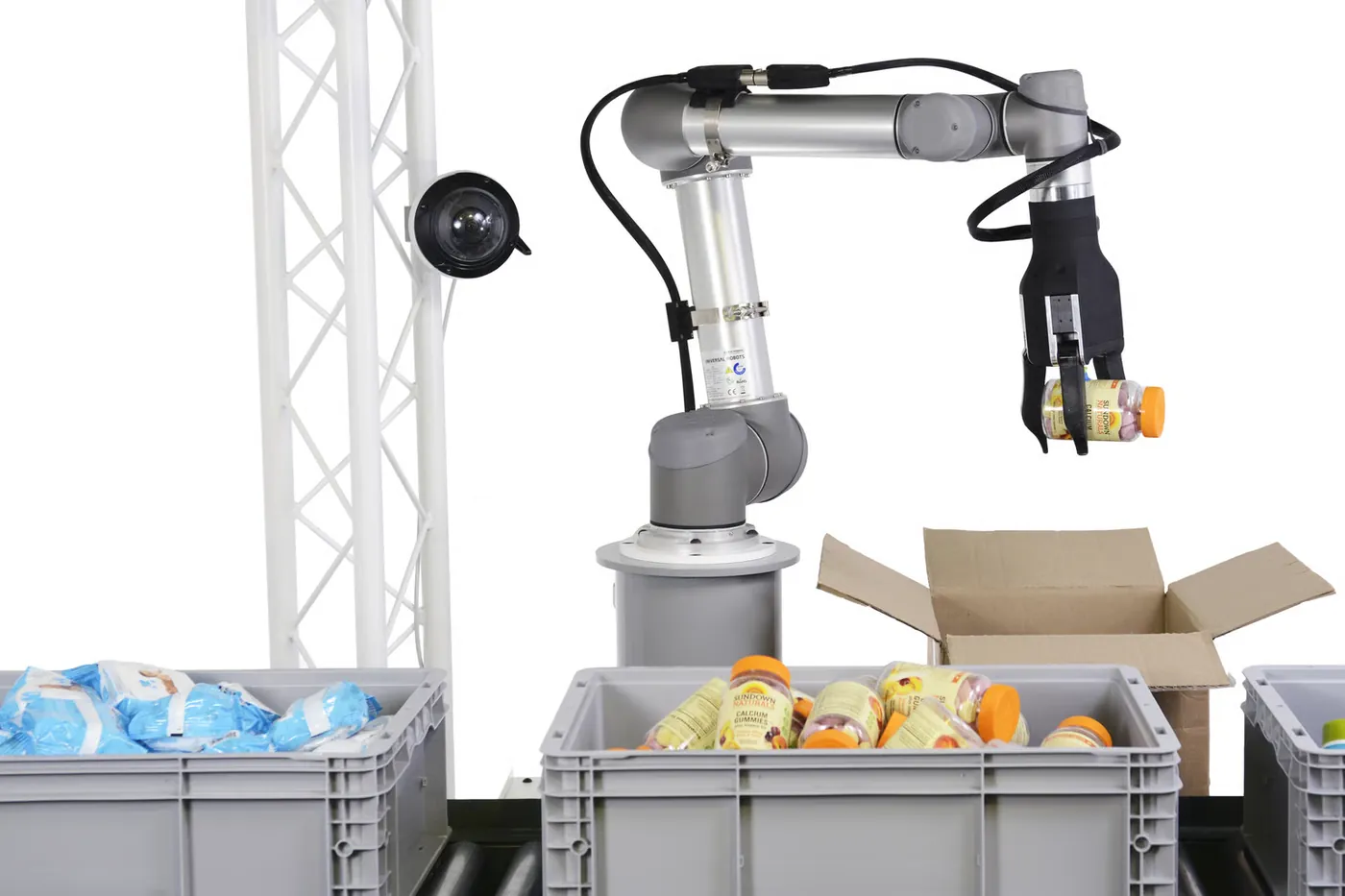
The world’s largest manufacturer and operator of mobile robotics runs more than a million robots across hundreds of fulfillment facilities worldwide. At that scale, the robots don’t just move things; they have to understand what they’re moving, assess its condition, and make packing decisions in real time, continuously, without human intervention.
That requires perception. Not just cameras. Not just detection. A system that takes in data from multiple sensors simultaneously, processes it fast enough to keep up with warehouse throughput, and feeds accurate, actionable information to the downstream systems making the decisions.
Detection is the easy part. Understanding is the hard part.
A robot that can detect an object isn’t useful on its own. It needs to know what the object is, what condition it’s in, where it is in three-dimensional space, and how it relates to everything around it, all in the time it takes the line to keep moving.
Building that capability means solving several problems at once: sensor integration, data quality, computational throughput, and making the whole system flexible enough to work across object types, packaging formats, and camera configurations that change as the fleet evolves.
// 02, What Geisel Built
A perception stack built to extend, not just integrate.
Multi-Camera Sensor Network for Real-Time Warehouse Perception
Geisel developed a robust sensor network built around camera sensors and their seamless integration with the robot’s broader systems. The architecture isolated camera sensor drivers from the interface service logic, a deliberate design decision that meant adding new camera types didn’t require rebuilding the system from the ground up.
That decision proved its value quickly. The client initially integrated two cameras. When they saw how the system performed, they asked Geisel to add six more, each with different characteristics. The architecture handled it. That’s not an accident. It’s what good sensor fusion engineering looks like.
Computer Vision Across RGB and LiDAR for Object Detection and Identification
Object detection ran on both RGB and LiDAR data simultaneously, enabling the robot to detect multiple objects at once across different sensing modalities. Barcode scanning and optical character recognition (OCR) on RGB images gave the robot the ability to accurately identify objects and assess their condition, not just locate them.
The combination of spatial data from LiDAR and visual data from RGB cameras gave the system a richer, more reliable picture than either could provide alone.
GPU-Accelerated Processing for Strict Real-Time Requirements
Image processing at this scale and speed has real computational demands. Geisel used CUDA for GPU acceleration to meet the strict timing requirements the warehouse environment imposed, ensuring imaging data and analysis were delivered when the downstream systems needed them.
The perception system has one job: give the robot enough understanding of what it’s holding to pack it correctly. Everything downstream, packing strategy, space optimization, throughput, depends on that being right.
At this scale, a warehouse doesn’t tolerate perception errors. If a robot misidentifies an item, misjudges its dimensions, or feeds bad data into the packing system, it doesn’t just slow the line, it breaks it. The software has to be right. Every time. Across every object that moves through the system.
Warehouse Robotics · Perception System