// 01, The Mission
The first minutes determine outcomes.
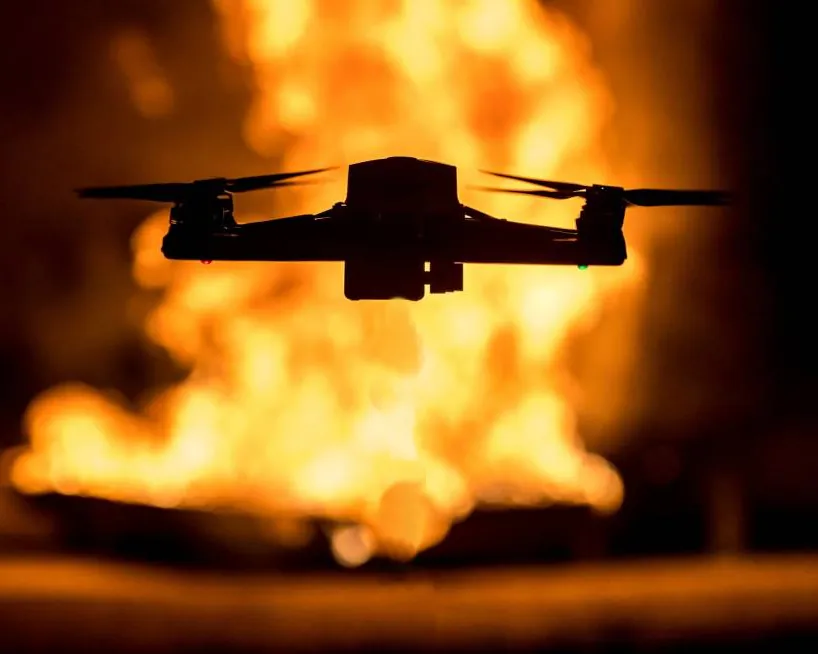
When a fire department gets a call, the first minutes determine outcomes. Commanders make decisions based on what they can see, and in most responses, what they can see is limited to what’s visible from the ground. By the time aerial reconnaissance is available, the situation has already evolved.
SafeOps Systems was built around a different premise: autonomous UAVs deployed ahead of responders, streaming live video and sensor data to a unified command platform before boots hit the ground. The right information, to the right people, fast enough to matter.
The vision was clear. Building it was the hard part.
// 02, The Problem
Low-cost UAV hardware is only useful if the software works under pressure.
SOS needed a working system: an off-the-shelf drone integrated with existing dispatch software, capable of streaming HD and thermal video over cellular, supporting multiple simultaneous UAV feeds from the cloud, and designed to fly beyond visual line of sight in compliance with FAA regulations.
Off-the-shelf hardware doesn’t come with any of that. Every piece of it had to be engineered.
// 03, What Geisel Built
From requirements to first customer demonstration.
Geisel was SOS’s primary software development team from day one, owning the program from initial requirements and architecture through development, integration, and the first customer demonstration.
Autonomous UAV Command Software for Public Safety Operations
The core of SOS Live is a virtual command platform that gives operators control over UAVs, cameras, sensors, and mobile devices from a single interface. Geisel built the autonomous behaviors that make it operationally useful: low-latency video streaming, path planning, and obstacle avoidance using county LiDAR maps of terrain and objects.
For a first responder platform, latency isn’t a performance metric; it’s a safety requirement. A video feed that’s two seconds behind reality is a feed that can’t be trusted. Getting that right under real-world cellular conditions, across multiple simultaneous UAV streams, was one of the core technical problems Geisel solved.
Cellular Communication Replacing WiFi for Field-Deployable Operations
WiFi-dependent drone systems work in controlled environments. They don’t work at a fire scene or an active incident where infrastructure is compromised or nonexistent. Geisel replaced WiFi dependency with cellular communication, making the system deployable in the conditions first responders actually operate in.
FAA-Compliant Beyond-Line-of-Sight Flight
Operating UAVs beyond visual line of sight requires compliance with FAA regulations that most prototype systems never reach. Geisel designed and implemented the safety features required for compliant BVLOS operations, a prerequisite for real-world deployment, and a meaningful barrier that separates proof-of-concept systems from systems that can actually be used.
Edge Cloud Architecture for Mission-Critical Equipment
SOS Live is an edge cloud solution that connects and automates mission-critical equipment. Geisel architected the platform so that data flowing from UAVs, cameras, and sensors arrived reliable, low-latency, and structured for real-time decision-making under pressure, with cloud-side support for multiple UAVs streaming video simultaneously.
// 04, The Result
It worked the first time it was shown to a fire department.
The first customer demonstration, delivered to a local fire department, was a success. The program marked a significant milestone for SafeOps Systems and laid the groundwork for their first Small Business Innovation Research (SBIR) award application.
A platform built for the moment a fire department needs it to work had to work the first time it was shown to a fire department. It did.
First responders make life-and-death decisions based on what their technology shows them. If a platform lags, drops a feed, or loses a UAV in the field, the failure shows up right when it matters most. Geisel built SOS Live for that reality.
SafeOps Systems · SOS Live Command Platform