
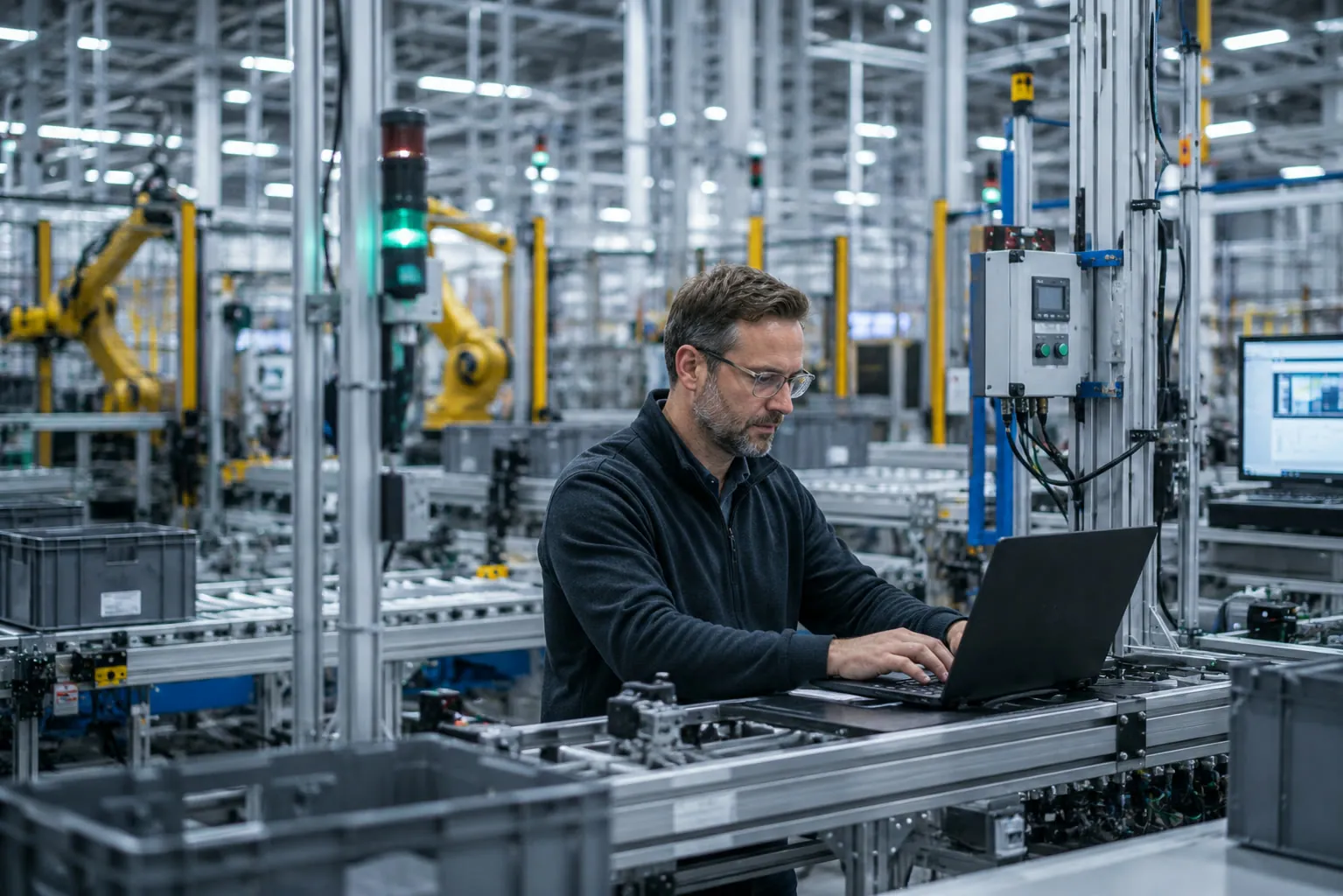
Forward-deployed engineering is a delivery model in which senior engineers embed directly inside a customer’s team and environment to build and deploy production systems, rather than advising from the outside. Instead of handing you a report or a prototype, forward-deployed engineers ship working software in the place where it has to run.
If you run an engineering organization, you’ve probably started hearing this term everywhere over the past year, usually attached to AI companies. I’ve been running this model for years in robotics, autonomy, and embedded systems, long before it had a trendy name, so I want to give you the straight version: what it is, where it came from, why demand has exploded, and how to tell whether you actually need it.
What is forward-deployed engineering?
Forward-deployed engineering (FDE) is an engagement model where senior engineers work inside a customer’s operation, using the customer’s real systems, data, hardware, and constraints, to deliver software that runs in production.
Wherever the model is practiced, I see the same four traits:
- Engineers embed with the customer’s team instead of working at arm’s length.
- The work happens in the customer’s real environment, not a sandbox.
- The deliverable is deployed, working software, not a recommendation.
- The same engineers who scope the problem are the ones who build and deploy the solution.
Where did forward-deployed engineering come from?
Palantir coined the role in the early 2010s, deploying engineers inside government agencies and Fortune 500 companies to make its data platforms work against messy, high-stakes operational reality. The model is widely credited as a structural advantage behind Palantir’s success, and for over a decade it remained mostly a Palantir idea.
Then the AI industry hit its deployment problem, and the model went mainstream. In May 2026, OpenAI launched The Deployment Company, a $10 billion venture built entirely around embedding engineers inside enterprise deployments, and Anthropic followed with a $1.5 billion enterprise services joint venture. Salesforce publicly committed to hiring 1,000 forward-deployed engineers. Box CEO Aaron Levie has called the forward-deployed engineer one of the most important roles in enterprise AI adoption, and Google Cloud CEO Thomas Kurian has said Google is expanding FDE hiring in direct response to customer demand.
I take all of this as validation of something I’ve believed my whole career: the bottleneck to getting advanced systems into production isn’t the technology. It’s the last mile of deployment, and closing it often requires engineers in the room.
One distinction worth knowing before you sign anything: forward-deployed engineers at product companies embed to deploy their employer’s platform, while independent forward-deployed engineers embed to build and deploy your system, with no platform to sell.
Why is forward-deployed engineering suddenly everywhere?
Because a demo and a production system are two different problems. A demo proves the idea under conditions you control. Production has to hold up under all the conditions you don’t, and that second problem is the one the industry has been failing at. The market’s answer has been to put engineers on-site rather than advisors on a call, and the hiring data shows how fast: job postings for forward-deployed engineers on Indeed grew 729% year over year, from 643 postings in April 2025 to 5,330 in April 2026.
The money is following the hiring. On July 2, 2026, Microsoft committed $2.5 billion and roughly 6,000 engineers to Microsoft Frontier Company, a new operating unit that embeds those engineers inside customer operations to build and run AI systems.
The driver behind that curve isn’t hype. It’s failure. MIT’s Project NANDA studied enterprise AI adoption in 2025, reviewing more than 300 public initiatives alongside 52 interviews and 153 executive surveys, and found that despite $30 to 40 billion in spending, 95% of organizations saw no measurable P&L return. The models worked. The deployments did not. The study’s own diagnosis was integration: systems that don’t retain feedback, don’t adapt to context, and break inside real workflows. In physical systems, the same wall has extra bricks: real sensor noise instead of clean datasets, degraded conditions instead of ideal ones, latency budgets, edge cases, and the requirement that the system behave correctly the first time and every time.
The same study contains the finding an engineering director should sit with: external partnerships succeeded roughly twice as often as internal builds. The organizations crossing the wall aren’t the ones with the biggest AI budgets. They’re the ones that brought in engineers who had crossed it before.
This is called the deployment wall. It sits between a working pilot and a production system, and it’s where the overwhelming majority of these projects die. If you’re reading this as a director of engineering, I suspect you already know exactly where your wall is.
The AI industry is just now learning what robotics, autonomy, and embedded systems have always known: there’s no version of this work that stops at the demo. When software controls a physical system, you don’t get to patch your way out of a bad deployment. A robot that misreads its environment hits something. A medical device that fails gets recalled. Deployment isn’t the last mile of the job. It’s the job.
How is FDE different from consulting and staff augmentation?
If you’ve run an engineering organization for any length of time, you’ve probably bought at least two of these models before, and possibly all four. They’re easy to confuse because all of them involve outside people helping your team. The difference is in what they deliver and how much they own.
| Forward-deployed engineering | Traditional consulting | Staff augmentation | Project-based outsourcing | |
|---|---|---|---|---|
| Primary deliverable | Deployed, production software | Analysis, strategy, recommendations | Additional hands on your backlog | Software built to a spec |
| Where the work happens | Inside your environment and systems | Often external, then handed back | Inside your team and process | External, delivered at milestones |
| Who owns the outcome | The vendor, through deployment | The client, after the report | The client, task by task | Shared, until handoff; then the client |
| Exposure to real conditions | Constant, by design | Limited | Depends on the task | Minimal until integration |
| Seniority | Senior engineers who build and deploy | Advisors and analysts | Varies, often mid-level throughput | Varies widely |
| Best for | Getting a hard system into production | Deciding what to do | Adding capacity to a known plan | Well-specified builds with stable requirements |
Consulting answers what should we do. Staff augmentation adds capacity to do it. Project-based outsourcing builds what you specify, and works well when the spec is stable and the integration risk is low. Forward-deployed engineering is for the opposite case: when the requirements are shaped by real-world conditions you can’t specify in advance, and the people advising you’re the same people who have to ship.
What does a forward-deployed engagement actually look like?
When I evaluate whether an engagement is truly forward-deployed, I look for four things:
- Embedded, not remote. Engineers work alongside your team, in your environment, on your hardware, against your real constraints.
- Senior, not layered. The engineers who scope the work are the engineers who do it. There’s no pitch team followed by a junior handoff.
- Integrated, not replacement. A good partner augments the team you have and accelerates the specific bottleneck, rather than taking over or starting from scratch.
- Accountable through deployment. The engagement owns the technical outcome to the point the system works in the field, not a scoped artifact you’re left to integrate later.
When should a company use forward-deployed engineering?
Forward-deployed engineering is the right model when the stakes and the timeline are real and the problem is genuinely hard to get into production. The signals I look for:
- You have a funded program with a defined delivery date, not an exploratory idea.
- You have a capable team that lacks specific depth in an area like autonomy, perception, edge AI, or embedded systems.
- The system has to behave correctly in the real world, under real conditions, where a bad deployment carries real consequences.
- A pilot works, but you can’t get it reliably into production.
Underneath all four signals is one filter: accountability. Anyone can hand you a body and a dream. Owning the outcome through production is different: that willingness is itself evidence of competence, and a vendor selling effort instead of outcomes is telling you something.
These conditions show up wherever software meets the physical world, like robotics and warehouse automation, or wherever you lack the capacity to solve customer problems while staying focused on your core product.
If instead you mainly need a decision about direction, hire a consultant. If you have a clear plan and simply need more throughput, staff augmentation or a project-based build will serve you better and cost you less. Forward-deployed engineering is for when you need a hard system to actually work in the field.
What should you look for in a forward-deployed engineering partner?
Evaluate anyone selling you this model on evidence that they can deliver in production, not just offer advice and plenty of management resources:
- A track record of deployed systems in environments as demanding as yours, not just prototypes or slideware.
- Senior engineers on your program, with the people who scope the work also doing it.
- Domain depth in the specific hard problem, such as autonomy, perception, or embedded and edge systems.
- Ownership of outcomes through deployment, rather than a deliverable that ends at a document.
- No product agenda. Ask whether the partner’s recommendations are also a sales motion. Independence matters most at exactly the moments when the honest answer is inconvenient.
The bottom line
Forward-deployed engineering is an old discipline with a new name. The gap between a demo and a production system has always existed. What’s changed is that the industry now has data showing how expensive it is to ignore. The model works for a simple reason: it puts the people who understand the constraints in direct contact with the constraints themselves.
The decision comes down to where your risk lives. If it’s in choosing a direction, hire an advisor. If it’s in throughput, add capacity. If it’s at the boundary between your software and the environment it has to operate in, that risk doesn’t resolve from a distance, and your engagement model should reflect that.
Frequently asked questions
What does a forward-deployed engineer do?
A forward-deployed engineer embeds inside a customer’s team and environment to build and deploy production software, using the customer’s real systems and constraints. They own the technical outcome through deployment, rather than producing analysis or recommendations.
How is forward-deployed engineering different from consulting?
Consulting delivers analysis and recommendations that the client then acts on. Forward-deployed engineering delivers working, deployed software, and the same engineers who scope the problem build and ship the solution.
Is forward-deployed engineering the same as staff augmentation?
No. Staff augmentation adds capacity to an existing plan, usually task by task. Forward-deployed engineering owns a hard technical outcome and delivers the production system, integrating with your team to accelerate the specific bottleneck.
What is the difference between a product-company forward-deployed engineer and an independent one?
A product-company forward-deployed engineer, like those at Palantir or OpenAI, embeds with customers to deploy their employer’s platform. An independent forward-deployed engineering firm embeds to build and deploy the customer’s own system, with no platform to sell and no product agenda behind its recommendations.
Why is demand for forward-deployed engineers growing so fast?
Job postings for forward-deployed engineers grew 729% year over year on Indeed through April 2026, driven by the gap between working pilots and production systems. An MIT NANDA study found 95% of organizations saw no measurable return on enterprise AI, with failures concentrated in integration rather than the underlying technology.
When should a company use forward-deployed engineering?
When you have a funded program with a real delivery date, a capable team that needs specific depth, and a system that has to work correctly in the real world. It’s especially valuable when a pilot works but won’t reach reliable production.
What industries use forward-deployed engineering?
It’s common wherever advanced software has to work in demanding, real-world conditions, including robotics and autonomy, aerospace and defense, industrial and manufacturing systems, medical devices, and agriculture technology.
If you have a system stuck between pilot and production, I’d like to hear about it. Start an engineering conversation.